
'Disengagement is merely the first step in a lengthy process of arriving at a new normal along the LAC in Eastern Ladakh and the entire land boundary.' 'The Indian government should insist on the restoration of the status quo ante in Eastern Ladakh.'

"After the Major General-level talks on Wednesday, the talks are expected to be held over the next few days in Chushul at multiple levels to find solutions to the dispute in specific areas," sources said.

'The greatness of India can be experienced by meeting Indians on the frontiers of India.' 'Every citizen on the border is a soldier'

India and China on Friday held 'in-depth' discussions on addressing the remaining issues along the Line of Actual Control (LAC) in eastern Ladakh, holding that disengagement in the North and South banks of Pangong lake provided a good basis to work towards their early resolution.
The US hopes that the differences will be resolved peacefully, officials said in Washington.

India and China are in touch to resolve the situation arising out of the 'deep incursion' by Chinese troops, who entered the Indian territory in Daulat Beg Oldi sector in eastern Ladakh and erected a tented post. According to government sources, the issue was raised by India after the incident came to light some time ago.

It is learnt that the face-off took place after a Chinese patrol tried to enter Indian territory and the troops of China's People's Liberation Army were forced back.
The development comes after after reaching a consensus in the 16th round of military talks, the two sides said in a joint statement this evening.
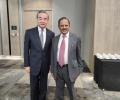
National Security Advisor Ajit Doval held a meeting with top Chinese diplomat Wang Yi during which he emphasised the need for continuing efforts to restore peace and tranquillity in the border areas to remove the 'impediments' to normalcy in bilateral relations.
'The supreme art of war is to subdue the enemy without fighting' said the famed ancient Chinese military strategist Sun Tzu. That seems to be the ploy behind the Chinese intrusion in Ladakh, says Colonel (retd) R Hariharan
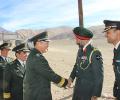
Amidst reports of Chinese incursions, the Peoples Liberation Army and the Indian Army on Sunday decided to uphold treaties and agreements signed between the governments of the two sides to maintain peace and tranquility along the Line of Actual Control.

China does not have to give up what it took in 2020, it will never give up its claim to Arunachal Pradesh, Ladakh and other areas, and it has all the time now to plan its next surprise, points out Lieutenant General Prakash Katoch (retd).
Prime Minister Manmohan Singh and Chinese Premier Li Keqiang signed the border agreement to ensure that both countries do not tail each other's military teams along the LAC. Sheela Bhatt reports from Beijing
After their troops remained in "face-to-face" situation for nearly three weeks, India and China have agreed to restore status quo along Line of Actual Control in Western Sector as it existed prior to April 15, when Chinese intruded into Indian territory there.
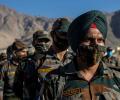
A joint statement released on Thursday said both sides exchanged views in an 'open and constructive' manner to resolve the 'relevant issues' and that it was agreed to maintain 'security and stability' on the ground in the region.

The stringent and rare action against Commandant Rajesh Kumar Tomar was confirmed by the ITBP director general after a general force court trial was held against him under the ITBP Force Act of 1992.
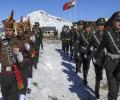
The two militaries are set to hold extensive talks on finalising modalities for restoring normalcy and bringing back peace and tranquillity in the region after the verification of the disengagement exercise is completed.

He said China has accrued significant capacities for force mobilisation, application, and sustenance of military operations and maintained the long-pending boundary issue can not be divorced from bilateral relations between the two Asian giants.

In a sudden development, India and China pulled back their troops from the stand off point at Daulat Beg Oldi sector in Ladakh, where the Chinese forces had intruded nearly three weeks back, official sources said on Sunday night.
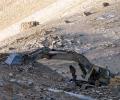
The 11th round of the Corps Commander-level talks began at around 10.30 am at the Chushul border point on the Indian side of the Line of Actual Control (LAC) in eastern Ladakh, they said.

As the military standoff between India and China drags on along the Line of Actual Control (LAC) in eastern Ladakh, Defence Minister Rajnath Singh said the talks between the two sides are going on well and indicated hope for a resolution of the lingering row.
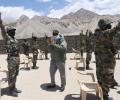
Only he, with his tremendous political capital and personal stature, can pull it off, observes B S Raghavan, the veteran civil servant.
'We think we are ready to have a practical, rational, logical kind of discussion whereas on the other side there is this kind of defensiveness,'says a senior Indian diplomat.

China on Friday operationalised its first fully electrified bullet train in the remote Himalayan region of Tibet, connecting the provincial capital Lhasa and Nyingchi, a strategically located Tibetan border town close to Arunachal Pradesh.

The number of Indo-Tibetan Border Police (ITBP) posts along the Line of Actual Control (LAC) has been increased from 180 to 195 as part of plans to better operational capability and border management, a top official said on Friday.

The marathon fourth round of Lt Gen-level talks also focussed on steps for pulling back large number of troops and weapons from rear bases along the Line of Actual Control in eastern Ladakh.
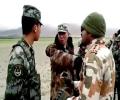
Over the last few weeks, bipartisan support for India against China has been increasing.
India will establish a joint mechanism with China in the next few months to resolve border issues while taking steps to modernise its military infrastructure in the face of Beijing "aggressively" shoring up its defence set up along the Line of Actual Control, Defence Minister A K Antony said on Tuesday.

'There have been equal or more casualties on the Chinese side.' 'Our soldiers are hardy and strong and far superior than the Chinese.'

Almost five years later, the three services have still not fully understood that joint/theatre commands are not a discussion point; they are the prime minister's diktat on a military reform measure that is in line with what armed forces around the world have implemented, points out Ajai Shukla.

India and China on Tuesday discussed the recent spate of incursions and ways to maintain peace and tranquility along the Line of Actual Control in the border areas.
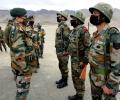
The seventh round of military talks between India and China held on Monday was "positive and constructive", and both sides agreed to earnestly implement the understanding reached by their leaders to not turn differences into disputes, a joint statement by the two armies said on Tuesday.
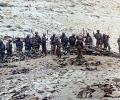
India on Thursday blamed China's actions of amassing a large number of troops close to the border and attempts to unilaterally alter the status quo along the Line of Actual Control (LAC) last year for the continuing military standoff in eastern Ladakh, and asserted that these acts were in violation of Sino-India bilateral agreements.

The defence minister said Prime Minister Narendra Modi and Chinese President Xi Jinping had an informal summit meeting at Wuhan where it was decided that peace and tranquillity will be maintained at the border.

Corps Commander-level meeting between armies of India and China was held in Chushul on Tuesday, to resolve the ongoing dispute over Chinese aggression along the Line of Actual Control (LAC) in Eastern Ladakh area, said Indian Army Sources.

In his conversation with Prime Minister Narendra Modi, President Xi Jinping stressed that improving China-India relations serves common interests and is conducive to peace and stability of the region and the world.
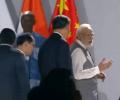
Prime Minister Narendra Modi conveyed to Chinese President Xi Jinping India's concerns on the "unresolved" issues along Line of Actual Control (LAC) in eastern Ladakh during a conversation on the sidelines of the BRICS summit, Foreign Secretary Vinay Mohan Kwatra said on Thursday.

"We will remember the soldiers' families, loved ones, and communities as they grieve," said Pompeo.
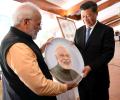
The right path for the two sides is to respect and support each other as this serves our long-term interests, Chinese foreign minister said.

The incident had taken place at a time when the Indian Foreign Minister, S Jaishankar, was in Moscow for the Shanghai Cooperation Organisation meeting, where he met his Chinese counterpart to address the border issues.
 © 2026 Rediff.com - Advertise with us - Disclaimer - Privacy Policy - Sitemap - Feedback - About us - Terms of use - Grievances